Why Your Business Isn’t Growing (Yet)
BRAND CLARITY | 6 min read
Published 13 May 2026 · Updated 28 August 2026
Sometimes the frustrating thing about a business that isn’t growing is that nothing seems obviously wrong.
The product is good. Customers like it. You’re putting the work in.
So why does it still feel like you’re pushing a very heavy boulder up a hill?

There’s a conversation I’ve had with business owners more times than I can count.
They’ve spent months developing something.
A new product.
A new service.
A new idea they genuinely believe in.
And then I ask:
“How are people going to find it?”
Sometimes there’s a very clear answer.
Sometimes there isn’t.
And that second answer is usually where things get interesting.
Because a business isn’t just the thing you sell.
It’s everything around it that helps the right people find it, understand it, trust it and eventually buy it.
That’s why a genuinely good business can still struggle to grow.
A good product isn't the same as a clear business
This is where the confusion usually starts.
When you’re building a business, it’s natural to focus on the thing you’re actually selling.
You improve the product.
You improve the service.
You make the website.
You get the logo sorted.
You start posting on Instagram.
All of those things matter.
But they don't necessarily answer some of the bigger questions:
Who is this really for?
Why would they choose it?
How are they going to discover it?
Do they immediately understand why it matters?
What happens between seeing you for the first time and becoming a customer?
If those answers aren't clear, adding more marketing can sometimes make the problem worse.
You're simply sending more people towards something that still isn't quite clear.
This is why I often come back to the idea of clarity before activity.
Before asking how to market the business, it's worth understanding what might actually be getting in the way.
The 9 areas I'd look at first
I've developed a simple way of looking at this called:
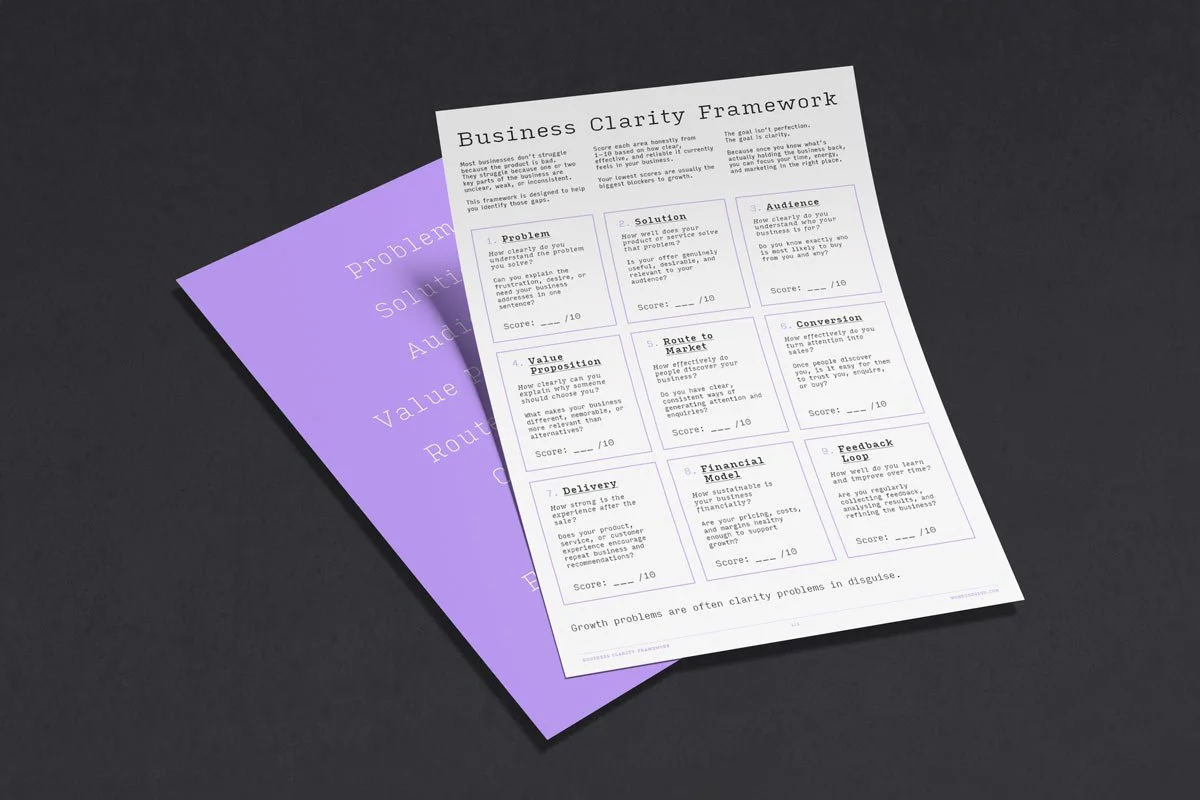
The Business Clarity Framework
It breaks a business down into nine areas.
You don't need every area to score 10/10.
The point is to spot where the biggest gap is.
1. Problem
2. Solution
3. Audience
4. Value Proposition
5. Route to Market
6. Conversion
7. Delivery
8. Financial Model
9. Feedback Loop
1. Problem
What problem are you solving?
Not just what you sell, but what changes for the customer because your business exists.
If the problem isn't particularly important to the people you're targeting, growth becomes difficult regardless of how good the solution is.
2. Solution
Does your product or service clearly solve that problem?
Sometimes the solution is genuinely good, but the connection between the problem and the solution isn't obvious.
If people have to work that out for themselves, you're making marketing harder than it needs to be.
3. Audience
Do you know who you're trying to reach?
“Anyone who needs this” usually isn't a particularly useful audience.
The clearer you are about who you're trying to attract, the easier it becomes to make decisions about messaging, marketing and positioning.
4. Value Proposition
Why should someone choose you?
This doesn't have to mean inventing a completely unique selling point.
It simply means being clear about the value you offer and why you're a good choice for the people you're trying to reach.
5. Route to Market
How do people actually discover you?
This one gets overlooked surprisingly often.
You can have a great offer and a clear audience, but if there's no reliable route between the two, growth is going to be difficult.
That route might be:
Instagram
Google
word of mouth
local footfall
partnerships
events
advertising
email
or a combination of several things
The important thing is knowing what it is.
6. Conversion
What happens when someone is interested?
Getting attention is only part of the job.
Can someone quickly understand what to do next?
Is it easy to enquire, book, buy or visit?
A surprising amount of potential business gets lost in this gap.
7. Delivery
Can you deliver the experience you're promising?
Growth isn't particularly useful if the business can't comfortably support it.
Think about capacity, customer experience, processes and everything that happens after someone says yes.
8. Financial Model
Does the business actually make enough money from what it's doing?
Revenue isn't the same as a healthy business.
You need to understand whether the products or services you're selling are commercially sustainable and whether growth would actually improve the business.
9. Feedback Loop
Are you learning from what happens?
Customers are constantly telling you things.
What they buy.
What they ignore.
What they ask about.
Why they come back.
Why they don't.
The businesses that pay attention to those signals tend to get clearer over time.
So where is your actual bottleneck?
This is the useful bit.
Imagine you score each area from 1 to 10.
You might end up with something like:
Problem: 9/10
Solution: 9/10
Audience: 5/10
Value proposition: 4/10
Route to market: 3/10
Conversion: 6/10
Delivery: 8/10
Financial model: 7/10
Feedback loop: 5/10
Suddenly, the picture looks quite different.
The business doesn't have a product problem.
It has a route-to-market and value proposition problem.
That's a much more useful thing to know.
Because now you can stop endlessly tweaking the product and start fixing the thing that's actually holding growth back.
Want to work through this yourself?
Download the Business Clarity Framework and score your business across the nine areas. It’s a simple way to spot where your biggest opportunities might be.
where businesses often go wrong
When growth slows, the temptation is to do something.
Anything.
Post more.
Run an advert.
Redesign the website.
Change the logo.
Launch another product.
Try a different social platform.
And sometimes those things are exactly what's needed.
But sometimes they're just ways of avoiding the more uncomfortable question:
What is actually stopping this business from growing?
I've written more about this in Growth Problems Are Often Clarity Problems in Disguise.
The distinction matters because activity can feel like progress even when it isn't solving the underlying problem.
Marketing can't fix everything
This is probably one of the most useful things to understand.
Marketing can create awareness.
It can bring people to your door.
It can help build trust.
But it can't automatically fix an unclear offer, weak positioning or a confusing customer journey.
If people don't understand what you do, getting more people to see it won't necessarily help.
If you're talking to everyone, reaching more people doesn't solve the audience problem.
And if people are interested but don't know what to do next, more awareness won't fix the conversion problem.
Sometimes the best marketing decision you can make is to stop and fix something underneath the marketing first.
That's one of the reasons I wrote Most Businesses Don't Need More Content. They Need More Clarity.
Growth usually starts with clarity
I don't think this means everything has to be perfectly figured out before you start marketing.
Far from it.
Businesses evolve.
You learn things.
You change your mind.
You discover who your best customers actually are.
That's all part of building a business.
The goal isn't to create a perfect plan and stick to it forever.
It's to have enough clarity to know what you're trying to do, who you're doing it for and where the biggest gap is right now.
Because once you know that, decisions get easier.
You know what needs attention.
You know what can wait.
And, perhaps most importantly, you stop trying to fix everything at once.
So, why isn't your business growing?
It might genuinely need better marketing.
But it might not.
It could be:
an unclear audience
weak positioning
a confusing offer
poor conversion
no reliable route to market
an inconsistent customer experience
or simply a business that's outgrown the way it used to operate
The important thing is to find the actual problem before deciding on the solution.
That's the whole point of the Business Clarity Framework.
Diagnose first. Then decide what to fix.
Want to find your biggest growth opportunity?
I've turned this thinking into the Brand Growth Scorecard.
It's a quick diagnostic designed to help you spot what's working, what's getting in the way and where your biggest opportunity lies.
It takes around three minutes and gives you a useful starting point for thinking about your brand and business more clearly.
And if you'd rather talk it through with someone, you can also book an in-person Brand Check Up at Pineapple Cafe or explore the other ways we can work together through Transformation.
Hope this helps,
Mark